Starting October 1, 2026, new compliance obligations introduced by Quality Control Orders (QCO) for various product categories will come into force in India. The impact also affects foreign companies exporting to the Indian market and concerns, among others, certain hand tools and equipment, aluminum products, and a broad category of electrical appliances intended for domestic, commercial, or similar applications.
For the products in question, compliance with the applicable Indian Standards and obtaining the relevant BIS certification do not represent a mere administrative formality: they constitute a necessary condition for importing and marketing the product in India.
For Italian companies already present on the Indian market, or planning to export to India in the coming months, it is therefore essential to promptly verify the applicability of the new QCOs to their products, identify the correct Indian Standard, and, when necessary, initiate the certification process with the Bureau of Indian Standards (BIS) in a timely manner.
In this article, we analyze what QCOs are, what the main product categories affected by the October 2026 deadlines are, what consequences they may have for Italian companies, and how to properly prepare for BIS certification.
What are Quality Control Orders (QCO) in India?
I Quality Control Orders they are measures issued by the various Ministries and Departments of the Indian Government with the aim of making compliance with specific product categories mandatory for Indian Standards defined by Bureau of Indian Standards.
La BIS certification it is indeed generally voluntary, but it becomes mandatory when a product is included in a specific QCO. In these cases, the product must comply with the Indian standard indicated in the provision and bear the relevant Standard Mark under the license or certificate required by the applicable scheme.
The objective of the Indian authorities is to progressively increase the quality and safety levels of products placed on the market by harmonizing the requirements applicable to local manufacturers and imported goods.
Once the QCO has entered into force, barring specific exemptions provided for by the measure, the products involved cannot be freely products imported, distributed, or marketed in India without the required compliance. It is therefore important to understand that the QCO does not concern only the finished product in a generic sense: the company must precisely identify product, technical characteristics, standard application field and production site.
What changes from October 1st, 2026?
According to the official list of Upcoming QCOs published by the Bureau of Indian Standards and updated to August 2026, several product categories will enter the mandatory application phase starting from October 1, 2026. Among the sectors of greatest interest for Italian companies, we can identify three broad areas.
Hand tools and professional equipment
A first category concerns various tools used in industrial, professional, and maintenance settings. Among the products indicated by BIS are, for example:
general-purpose pipe wrenches;
heavy duty pipe wrenches;
open-end wrenches;
ring spanners;
adjustable wrenches;
chain pipe wrenches;
open-ended and ring striking wrenches;
combination pliers with side cutter.
Each category is associated with a specific Indian Standard, which defines technical characteristics, performance, and requirements that the product must comply with. The topic may therefore be of interest not only to Italian tool manufacturers, but also to companies selling in India through local distributors, industrial operators, or group companies.
The following table summarizes the Indian standards applicable to each tool category:
Product category
Indian Standard
Effective date
General-purpose pipe wrenches
IS 4003 (Part 1): 1978
October 1, 2026
Heavy-duty pipe wrenches
IS 4003 (Part 2): 1986
October 1, 2026
Open-end wrenches
IS 2028:2004
October 1, 2026
Box wrenches
IS 2029:1998
October 1, 2026
Adjustable wrenches
IS 6149:1984
October 1, 2026
Chain pipe wrenches
IS 4123:1982
October 1, 2026
Open-end slack-tubing wrenches
IS 4508:1992
October 1, 2026
Slack-jointed slugging wrenches
IS 4509:1992
October 1, 2026
Combination pliers with side cutter
IS 3650:1981
October 1, 2026
Aluminum utensils and beverage cans
Starting October 1st, new deadlines are also scheduled for certain categories of aluminum products. In particular, the BIS list includes:
Wrought Aluminium Utensils, according to IS 1660:2024;
Aluminum Cans for Beverages, according to IS 14407:2023.
The relevant Quality Control Order establishes the obligation to comply with Indian standards and to use the Standard Mark required by the regulations.
Below is the detail of the applicable standards:
Product category
Indian Standard
Effective date
Wrought Aluminium Utensils
IS 1660:2024
October 1, 2026
Aluminum Cans for Beverages
IS 14407:2023
October 1, 2026
This is a particularly significant change for manufacturers and the supply chains linked to these sectors food & beverage, cookware, packaging and aluminum processing. Furthermore, the October deadline should not be considered an isolated intervention: the BIS calendar provides for further obligations relating to other aluminum products starting from December 1, 2026, including bars, profiles, plates, sheets, wires, tubes, and extrusions intended for different industrial applications.
The details of the standards affected by this second deadline are given below:
Product category
Indian Standard
Effective date
Aluminum bars, rods and profiles
IS 733:1983
December 1, 2026
Forged in aluminum and alloys
IS 734:1975
December 1, 2026
Aluminum plates
IS 736:1986
December 1, 2026
Aluminum foils and tapes
IS 737:2008
December 1, 2026
Aluminum wires
IS 739:1992
December 1, 2026
Aluminum rivets
IS 740:1977
December 1, 2026
Extruded round aluminum tubes and hollow sections
IS 1285:2002
December 1, 2026
Aluminum wires for electrical use
IS 2067:1975
December 1, 2026
Aluminum and alloys for tool production
IS 21:1992
December 1, 2026
Aluminum bars, tubes, sections, plates and sheets for electrical applications
IS 5082:1998
December 1, 2026
Electrical appliances: one of the new developments to monitor most closely
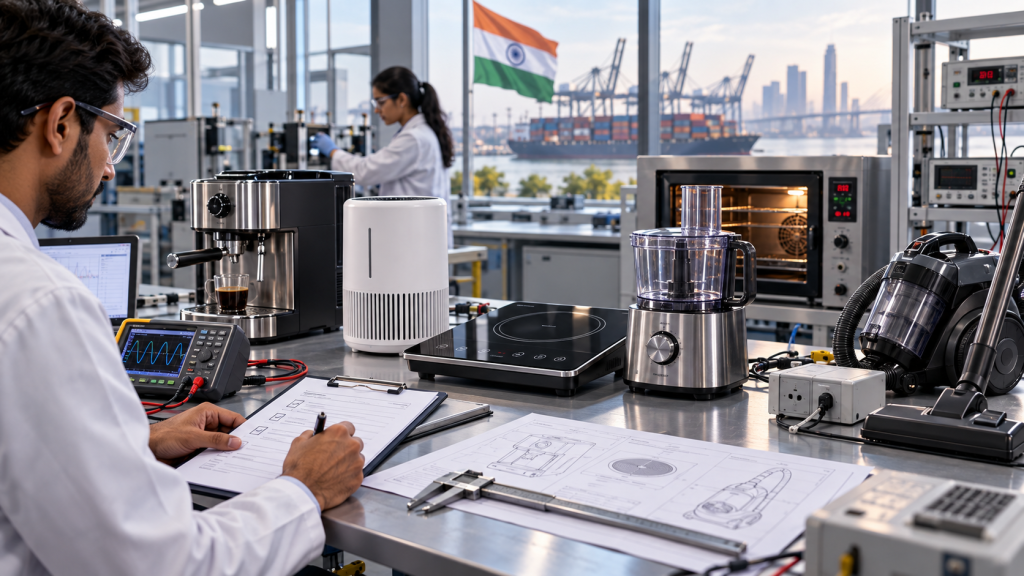
One of the potentially most extensive areas concerns electrical appliances for household, commercial or similar use, with a rated voltage not exceeding 250 V for single-phase appliances and 480 V for other appliances, including certain DC or battery-powered equipment.
The benchmark for this category is as follows:
Product category
Indian Standard
Effective date
Household electrical appliances,
commercial or similar
IS 302 (Part 1):2024 / IEC 60335-1:2020
October 1, 2026
The illustrative list published by the Bureau of Indian Standards is very extensive and includes, among others:
vacuum cleaners and cleaning appliances;
ovens, cooktops, and similar appliances;
deep fryers and electric griddles;
apparatus for heating liquids;
coffee machines and some coffee grinders;
food processors and food preparation appliances;
dishwasher;
electric machines for commercial kitchens;
air cleaning devices;
humidifiers;
commercial electric hoods;
personal care appliances;
electric garage door openers;
furniture with motorized components;
commercial vacuum packaging machines;
various battery-powered devices.
However, the presence of a product in an illustrative list is not sufficient, on its own, to determine the correct certification path.
The QCO dedicated to household, commercial, and similar appliances excludes from its scope products already regulated by other QCOs or already subject to specific BIS certification obligations. It therefore becomes essential to verify on a case-by-case basis whether a specific standard or provision already exists for the product.
For an Italian company, this probably represents one of the most delicate aspects of the new legislation: It is not always sufficient to start with the commercial description or the customs code of the product to determine which certification is applicable..
BIS Certification: what must an Italian manufacturer do?
When the product is actually subject to mandatory certification, the foreign manufacturer must initiate the process required by the Bureau of Indian Standards.
For manufacturers with plants located outside of India, one of the main tools is the Foreign Manufacturers Certification Scheme (FMCS), through which BIS can grant the foreign manufacturer a license to use the Standard Mark on products complying with the applicable Indian Standards.
The first step consists in correctly identifying the applicable standard. Subsequently, it is necessary to verify that the production site has the infrastructure, quality control processes, and testing capabilities required by the standard. Next, it is necessary to verify that the production site has the required infrastructure and quality control processes, as well as to evaluate the testing capabilities available internally and any external testing arrangements permitted by the applicable regulations.
In general, the path may include:
preliminary product analysis and identification of the applicable Indian Standard;
verification of the technical requirements set by the standard;
verification of production equipment, internally available testing capabilities, and any applicable external testing arrangements;
preparation of the required documentation;
appointment of’Authorized Indian Representative (AIR);
submission of the application to the BIS (including product evidence in the manner prescribed); ;
documentation evaluation;
inspection of the production site by the BIS;
product testing in accordance with the established procedures;
issuance of the license, in case of a positive outcome.
Indeed, the BIS clarifies that the license is granted based on the evaluation of the manufacturer's production infrastructure, processes, quality controls, and testing capabilities, through a plant visit and the verification of product compliance with the applicable standard.
The role of the Authorized Indian Representative
For an Italian producer, another fundamental element is the appointment of an’Authorized Indian Representative (AIR).
The AIR must be located in India and represents the foreign manufacturer in its dealings with the Bureau of Indian Standards, assuming specific responsibilities regarding compliance with the license conditions and BIS regulations. In the event that the manufacturer has its own branch or office in India, a suitable person belonging to the local structure may be appointed. In the absence of a direct presence in the country, the manufacturer may appoint an entity in India in compliance with the conditions established by the BIS.
It is also important to emphasize that the certification application must be submitted by the manufacturerAccording to the official BIS FAQs, the Indian importer cannot apply for the FMCS license on behalf of the foreign manufacturer. Consequently, relying entirely on one's Indian distributor or customer to handle the issue may not be sufficient.
Why Italian companies must act early
The October 1 deadline should not be interpreted as the date from which to start dealing with the certification.
Obtaining the BIS license can require a series of technical and documentary activities involving various company functions: technical department, quality, production, laboratory, export, and management. Before submitting the application, it may be necessary to verify:
if the product actually falls under the QCO;
which Indian Standard applies;
whether specific standards take precedence over the general rule;
which models or variants must be certified;
which tests must be performed;
which tests must be performed and in what manner, by verifying internal testing capabilities and the possible option of using external laboratories;
what adjustments may be necessary at the plant;
which entity to appoint as AIR;
what documents to submit to the BIS.
An incorrect assessment at this stage can lead to delays, additional costs, or difficulties in continuing exports. For companies that have pending orders or plan shipments to India in the months following the entry into force of the QCOs, it is therefore particularly important analyze your product portfolio destined for right away indian market.
India e-compliance: an increasingly strategic, but also more regulated market
The progressive expansion of Quality Control Orders is part of a broader transformation of the Indian industrial system.‘India is strengthening its product standardization, safety, and quality policies alongside the growth of the domestic market and the development of local production. For Italian companies, this does not reduce the country's attractiveness, but rather changes the conditions for approaching it.
Compliance must be considered increasingly as integral part of the market entry and development strategy in India, just like partner selection, commercial strategy, positioning, and distribution structure. Knowing the applicable requirements in advance not only helps avoid potential operational blocks, but also allows for the proper planning of timelines, investments, and commercial development.
How Octagona supports companies in BIS certification
With a direct presence in India and a specialized local team, We support Italian companies in analyzing the applicability of BIS regulations and in managing the entire certification process..
preliminary check of the product's applicability;
identification of the applicable Indian standard;
analysis of technical documentation;
verification of production and laboratory requirements;
assistance in preparing the application;
assistance in managing relations with the Bureau of Indian Standards;
support in appointing the Authorized Indian Representative;
preparation and assistance during the BIS audit at the Italian plant;
coordination of activities until the license is obtained.
For businesses already active on the Indian market, conducting a review before the new obligations enter into force makes it possible to promptly identify any critical issues and reduce the risk of export disruptions.
Conclusions
The October 1, 2026 represents an important new milestone in the process of extending Quality Control Orders in India.
Professional tools, aluminum products, and numerous categories of electrical appliances are among the areas to be monitored with the greatest attention, but the actual applicability of the certification must be verified based on the technical characteristics of each product and the specific Indian Standard.
For Italian companies exporting to India, the priority is therefore do not wait for the regulatory deadline, but to verify one's product portfolio in advance, identify any BIS obligations, and plan the certification path in a timely manner.
In a strategic and rapidly evolving market like India, anticipating compliance means protecting business continuity and building a stronger foundation for one's presence in the country.
Frequently asked questions about the new QCOs and BIS certification
What is a QCO in India?
A Quality Control Order is a measure by the Indian Government that makes compliance with a specific Indian Standard and the certification required by the Bureau of Indian Standards mandatory for certain product categories. Without this compliance, the product cannot be legally imported, distributed, or marketed in India.
Do QCOs also apply to products imported from Italy?
Yes. Except for specific exemptions provided by the individual regulation, the compliance obligations applicable to products governed by QCOs also apply to goods imported into India, including those originating from Italy. Exporting companies must therefore verify the applicability of the QCO to their products before starting or continuing shipments to the Indian market.
Which products will be affected starting October 1, 2026?
Among the categories listed in the official BIS list are various professional hand tools (such as pipe wrenches, open-ended spanners, and pliers), aluminum tools, aluminum beverage cans, and a wide category of household, commercial, or similar electrical appliances. However, applicability must be verified for each individual product, as each category is associated with a specific Indian Standard.
Must all electrical appliances be certified according to IS 302 Part 1:2024?
No. The regulations exclude from the general scope appliances already governed by other Quality Control Orders or other BIS certification obligations. It is therefore necessary to verify, product by product, whether a specific standard or provision applies before referring to the general IS 302 Part 1:2024 standard.
Can an Indian distributor obtain the certification instead of the Italian manufacturer?
Within the FMCS scheme, no. The application must be submitted directly by the foreign manufacturer, who must also appoint an Authorized Indian Representative (AIR) based in India. Entrusting the management of the certification entirely to one's Indian distributor or customer is therefore not sufficient to obtain the license.
How to know if my company needs to obtain BIS certification?
Verification crossing product technical characteristics, applicable Indian Standard, and reference Quality Control Order is required. A preliminary assessment, conducted by an expert consultant or the company's technical team, makes it possible to determine whether the product must be certified, is not subject to the obligation, or requires further regulatory analysis.
How soon is it advisable to start the BIS verification?
It is advisable to carry out the analysis as soon as possible with respect to the QCO entry-into-force date. The process may require document preparation, adjustment of testing capacities, appointment of the Authorized Indian Representative, submission of the application to the BIS, production site audit, and compliance testing: activities that, overall, can take several months.
SHARE ARTICLESassy Social Share
If you want to learn more about the content of this article








 Italian
  English