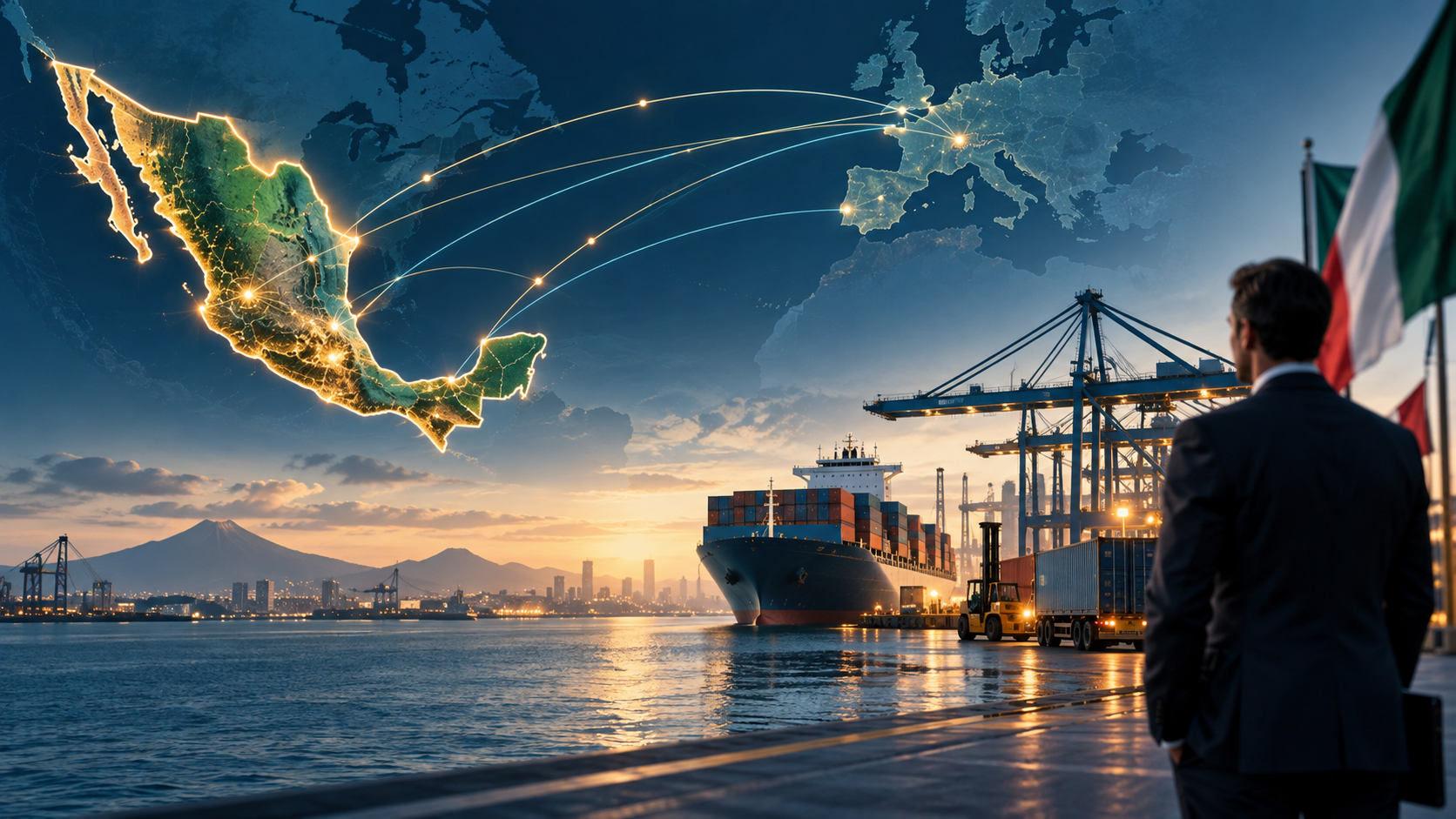
For Italian companies interested in expanding their business in the Americas, the’export to Mexico can represent a rapidly growing market and a strategic opportunity. Thanks to its favorable geographical location, free trade agreements, and continuous growth in domestic demand, Mexico offers a wide range of business possibilities. A key factor in this context is’trade agreement between the European Union (EU) and Mexico, which plays a central role in bilateral economic relations, strengthening political dialogue and cooperation between the two countries in various sectors.
The commercial provisions of the agreement were introduced in two phases: the first, concerning trade in goods, in 2000, and the second, concerning services, in 2001. In 2016, the two parties initiated a modernization process of the agreement to address new global economic challenges. An “agreement in principle” on the trade part of the new agreement was reached in April 2018, while technical details on public procurement were finalized in 2020. Currently, the updated agreement is in the process of concluding the necessary internal procedures on both sides, with the aim of consolidating and expanding mutual trade opportunities.
Required documentation for’Export to Mexico
Italian enterprises that intend to export to Mexico must pay attention to the proper preparation of documentation. The commercial invoice it is the first document required and must contain detailed information such as the HS code, country of origin, and an accurate description of the goods, with any serial numbers or technical identifications, to avoid misunderstandings. Another essential document is the packing list, which must be attached to the shipment andmust clearly specify the content, dimensions, and quantity of the exported items, thus facilitating customs operations.
Regarding the’product labeling, Mexico has specific regulations established by the standard NOM-050-SCFI-2004. It is essential for businesses to verify the current provisions for their sector, as labeling is one of the most critical aspects of import operations.
The importance of rules of origin
To obtain the benefits foreseen by the free trade agreement, it is essential to comply with the rules of origin, which determine the “economic nationality” of the traded products. These rules are essential to ensure that goods benefiting from preferential tariffs meet certain rules of origin. The rules of origin have been defined in Annex III of the Decision No. 2/2000 of the EC-Mexico Joint Council. and have undergone updates to reflect developments in customs classifications and technical specifications.
A product can benefit from preferential tariffs if it is entirely produced in the EU or Mexico, or if it is manufactured using non-originating materials, provided that these materials undergo sufficient transformations. In some cases, a certain percentage of non-originating materials can be used without compromising preferential benefits. The agreement, finally, provides for flexibility measures such as bilateral cumulation, which allows materials originating in Mexico to be considered as originating in the EU and vice versa, and the tolerance rule, which permits the use of up to 10% of non-originating materials.
How to apply for a preferential rate
To take advantage of the preferential rate for’export to Mexico, importers must provide proof of origin for the products, which can be certified by a EUR.1 certificate or through a declaration of origin. The EUR.1 certificate is issued by the “Secretaría de Economía” of Mexico and must be accompanied by the four-digit tariff classification of the product. If the total amount of the products does not exceed 500 euros for small packages or 1,200 euros for personal luggage, no proof of origin is required.
Alternatively, the authorized exporter or any other exporter with an overall value of less than 6,000 Euros may issue a declaration of origin, which must be signed and contain the necessary information to identify the products.
Enrollment in the Compranet system
Foreign companies can register for the Compranet system, a portal that allows participation in public tenders in Mexico. Registration requires the submission of various documents, including legal deeds and tax information, in digital format, to be included in the list of accredited suppliers by Mexican authorities.
Constraints to know for businesses that are interested in’export to Mexico
The Mexican market offers, therefore, many opportunities, there are still some constraints that companies must consider:
Restrictions on some food items: The entry of cured meats, sausages, and cheeses into Mexico is restricted for phytosanitary reasons. The competent authority, Sagarpa, issues the necessary authorizations for export by European companies, subject to inspection of the production facilities.
Customs uncertainties: Mexican customs does not always apply national regulations and international agreements uniformly, sometimes causing delays or difficulties in operations.
Labeling regulations: Labeling regulations are frequently updated, which can cause confusion for businesses. This is particularly relevant for food products, healthcare products, and machinery.
Specific authorizations for certain product categories: Some goods, such as electrical ones, require special authorizations from the competent authorities.
Economic implications and future opportunities
The EU-Mexico free trade agreement has not only simplified trade but has also improved diplomatic and cultural relations. Global trade tensions are creating new opportunities for Italian companies to expand into a growing Mexican market, also thanks to European investments and expertise.
L’export to Mexico This therefore represents a great opportunity, but companies must be well-prepared, know local regulations, and adapt to cultural dynamics. With the right support and a targeted approach, businesses can achieve significant results in this promising market.
For more detailed information or support, our team of experts in internationalization consulting, including through the Octagona service of temporary export management, is available to support your venture at every stage of the process.
SHARE ARTICLESassy Social Share
If you want to learn more about the content of this article





 Italian
  English