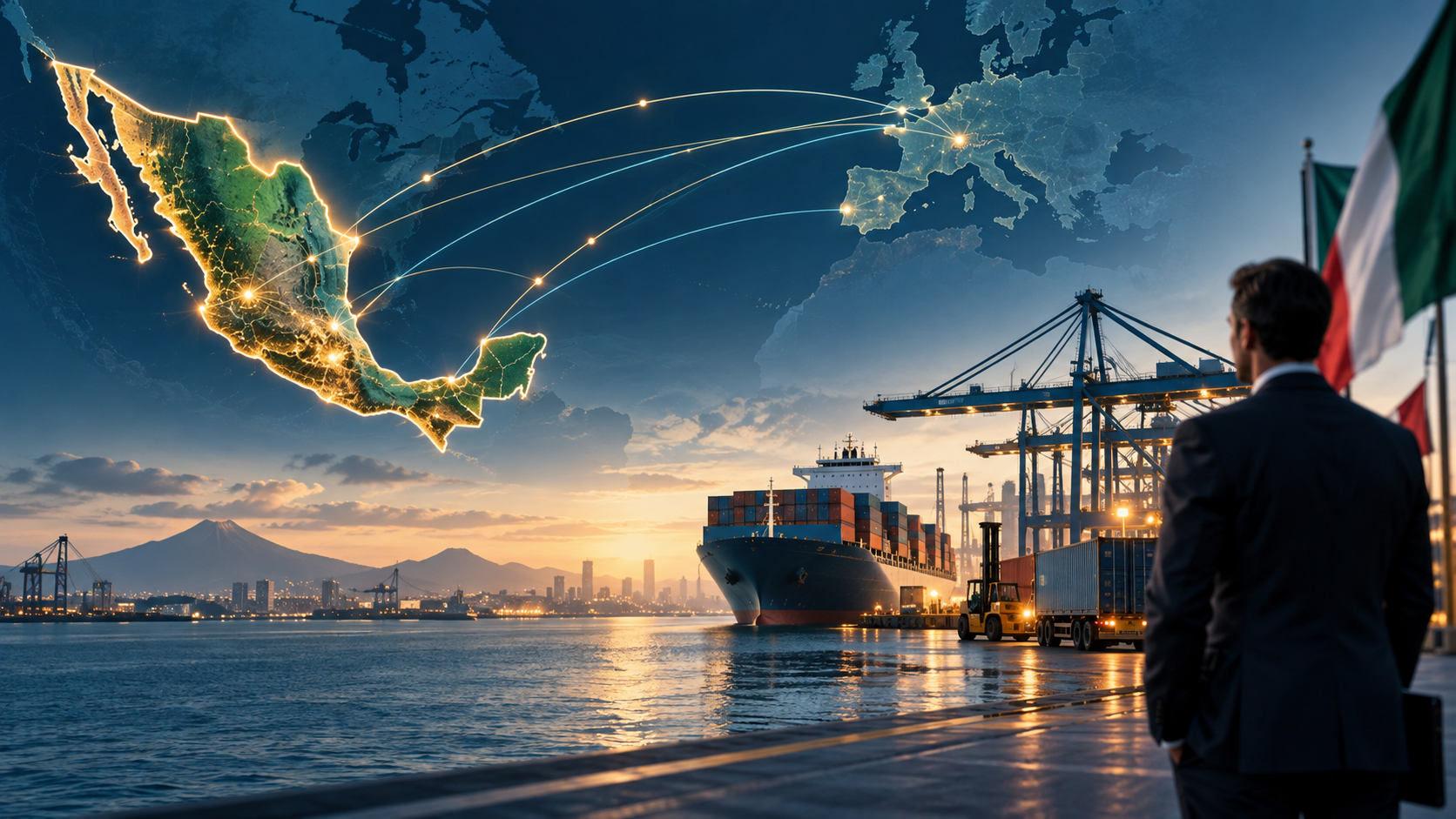
Mexico is playing an increasingly strategic role for Italian businesses looking to diversify their international markets and strengthen their presence in the American continent. On May 22, 2026, the European Union and Mexico signed the Modernised Global Agreement and the Interim Trade Agreement, updating the trade framework in force since 2000.
For Italy, already Mexico's second-largest partner among EU countries, the new agreement represents not only a potential reduction in tariffs, but a lever to rethink its internationalization strategy. In this article, we analyze what the agreement entails, the opportunities it generates for Italian companies, and how to prepare for its entry into force.
Key points of the 2026 EU-Mexico agreement
Company: May 22, 2026 (Modernised Global Agreement + Interim Trade Agreement)
Entry into force: scheduled after mutual EU-Mexico notification (first day of the second month following)
Agri-food tariffs: Elimination of ~95% Mexican tariffs on EU exports
Geographical Indications: 568 protected PGIs, of which 64 are Italian
Public procurement extended access to Mexican sub-federal procurement
Italian sectors most interested: machinery, automotive, agri-food, pharmaceutical, infrastructure
Why is Mexico strategic for Italian businesses in 2026?
Mexico occupies a unique position in the international economic scenario.
On the one hand, it represents one of the major economies of Latin America, with a domestic market of about 130 million inhabitants; on the other hand, it is deeply integrated into North American production chains. This dual dimension, domestic market and industrial platform towards the American continent, makes the country particularly interesting for European manufacturing companies. Mexico indeed has an important industrial base in the automotive, aerospace, electronics, home appliances, mechanical, pharmaceutical, food processing, and energy sectors, with developed production clusters in various areas of the country. At the same time, economic relations with Europe have reached significant dimensions.
In 2025, trade in goods between the European Union and Mexico reached approximately 87 billion euros, of which:
53 billion of European exports to Mexico;
34 billion euros of Mexican exports to the EU.
The stock of European investments in the country had also reached approximately 207 billion euros in 2024, while beyond 45,000 European companies they are already exporting to the Mexican market. Figures that explain why Brussels considers Mexico one of its strategic partners on the American continent.
What the new EU-Mexico agreement provides for?
Commercial relations between the two areas are already regulated by an agreement that entered into force in 2000. However, in over twenty-five years, the structure of economies, supply chains, digital commerce, and international investments have changed profoundly.
For this reason, the EU and Mexico have initiated a process to modernize the agreement, which concluded with the signing, on the May 22, 2026, of two instruments:
l’Interim Trade Agreement (iTA), dedicated to the commercial components within the exclusive competence of the European Union.
The new agreement addresses numerous areas: trade in goods, rules of origin, customs procedures, services, investments, public procurement, intellectual property, digital trade, sustainability, and access to raw materials. The objective is to create a more modern and predictable framework for businesses operating between the two markets.
Has the EU-Mexico agreement already entered into force?
A September 2026, the new trade agreement has been signed but It is not operational yet. The European Parliament gave its consent on July 8, 2026, and the Council of the EU formally concluded the European procedure for the Interim Trade Agreement on July 14.
It remains to complete the procedure outlined in Mexico. According to the established mechanism, the ITA will enter into force on first day of the second month following the date on which the EU and Mexico have notified each other of the completion of their respective internal procedures. For Italian businesses, therefore, this period represents a particularly interesting window: It is not yet time to automatically apply the new commercial terms, but it is the right time to understand them and prepare.
Which tariffs are eliminated with the new EU-Mexico agreement?
One of the main elements of the new agreement concerns the elimination of many of the tariff barriers still in place. The previous agreement had already liberalized a significant portion of industrial trade. The modernization further extends the process, focusing above all on categories that retained high tariffs or other restrictions. The benefit will be particularly evident in the agri-food sector.
According to the European Commission, the new agreement will make it possible to eliminate about 95% of Mexican tariffs still applied to European agri-food exports. For some products currently subject to high tariffs, the change can be significant. Among the examples indicated by the European Commission:
some cheeses are now subject to duties of up to 45%;
pasta may be subject to duties of up to 20%;
chocolate and confectionery products up to 20%;
Some meat categories record even higher tariff levels.
The agreement provides for immediate eliminations, tariff rate quotas, or progressive reductions, depending on the product. For Made in Italy agri-food products, this is a particularly interesting opportunity.
EU-Mexico Agreement: stronger protection for Made in Italy
Another relevant element concerns the protection of European Geographical Indications. The new agreement will lead to 568 EU Geographical Indications protected in Mexico, strengthening protection against imitations and improper use of European designations. For Italy, this issue takes on particular significance.
According to the Italian Ministry of Foreign Affairs, there will be 64 Italian Geographical Indications protected under the agreement. For producers of premium food & beverage, this means being able to enter the Mexican market with greater tools for protecting the brand, origin, and distinctive positioning of the product. But the agri-food sector is just one of the areas involved.
Machinery and automation: Made in Italy already starts from a strong position
One of the most promising sectors for Italian businesses remains that of machinery and industrial technologies. In 2024, machinery and equipment accounted for approximately 35.5% of Italian exports to Mexico, resulting in the top category of our exports to the country. This was followed by transport equipment, metal products, other manufacturing activities, chemicals, and the textile-clothing sector. The data highlights a structural complementarity. In fact, an increasingly developed Mexican manufacturing system requires:
Industrial automation;
Machine tools;
lines and production plants;
packaging and bottling technologies;
food industry machinery;
technologies for ceramics, glass, and wood processing;
components;
quality control solutions;
technologies for production and energy efficiency.
These are precisely some of the areas in which the Italian manufacturing system possesses recognized skills and specializations. The new agreement can further improve the conditions for operating in the market through the reduction of trade barriers and greater trade facilitation.
Automotive and components: why is Mexico a strategic hub?
Mexico also represents one of the main automotive hubs in the American continent. Numerous global automakers and a very extensive supply chain of component, system, processing, and industrial technology manufacturers operate in the country. The Italian presence is already significant. Among the Italian groups present in the sector are Stellantis, Pirelli, Brembo, and numerous SMEs integrated into local production chains. For Italian component and production technology companies, the Mexican market can therefore be evaluated not only based on local demand, but as part of a broader industrial strategy targeting the North American continent. In this sector, however, it becomes essential to carefully analyze rules of origin, supply chain structure, and final destination of products, especially when Mexican production is subsequently destined for other markets.
Pharmaceutical and medical: what opportunities for Italian companies?
The pharmaceutical and health technology sector also presents interesting possibilities. The same European documentation relating to the new agreement identifies pharmaceuticals, machinery and transport equipment among the sectors that will benefit from the improvement in market access conditions. Several Italian companies in the life sciences sector are already present in Mexico, either directly or through commercial and production facilities. Opportunities may emerge for Italian SMEs in areas such as:
pharmaceutical machinery and technologies;
packaging;
devices and components;
diagnostic;
laboratory technologies;
pharmaceuticals and healthcare.
However, market access must be accompanied by a proper assessment of local regulatory requirements.
Public procurement: what opportunities do they open up for Italian businesses?
One of the least visible, but potentially most interesting innovations of the new agreement, concerns the public procurement. The agreement aims to allow European companies to participate in a broader range of Mexican public procurement tenders. For the first time, access is also extended to opportunities at sub-federal level, in addition to central government procurement, while the principles of transparency and non-discrimination are being reinforced. This can create new opportunities especially for companies active in:
infrastructure;
Energy;
water and environmental treatment;
transportation;
health technologies;
digitization;
engineering;
industrial technologies.
For many Italian SMEs, this is a less known commercial channel compared to the traditional relationship with importers and distributors, but one that deserves to be monitored.
Services and investments: which sectors benefit from the agreement?
The new agreement is not exclusively about goods. An important part is dedicated to services and investments, with better access conditions in sectors such as:
financial services;
telecommunications;
transportation;
environmental services;
postal and courier services;
digital commerce.
There is also a specific chapter on digital trade, with the aim of reducing barriers to online activities and creating greater regulatory certainty for businesses. This aspect reflects a major transformation in internationalization: entering a new market no longer just means exporting a physical product, but can mean selling services, managing digital platforms, transferring technologies, or building local operational structures.
Italy and Mexico: an already consolidated economic relationship
Italian companies do not start from scratch. According to the Embassy of Italy in Mexico City, in the country there are about 2,300 Italian companies, of which approximately 200 have production facilities. The Italian system is present in numerous sectors such as automotive;
Energy;
infrastructure;
steel industry;
pharmaceutical;
oil & gas;
food;
industrial technologies;
construction.
In 2025 Italy was also the Mexico's second largest partner among EU countries and the twelfth largest supplier in the world, with a market share of 1.5%. The new agreement therefore arrives on an already developed commercial terrain and can offer Italian companies an additional tool to consolidate or expand their presence.
What are the most interesting sectors for Italian companies?
Considering the structure of Mexican demand, the specialization of Italian exports, and the new features introduced by the agreement, certain areas are particularly interesting.
Industrial machinery and automation
They already represent the main driver of Italian exports to the country and can benefit from investments in the modernization of the Mexican manufacturing base.
Automotive and components
The size of the Mexican automotive industry opens up opportunities for components, systems, processing, automation, and production technologies.
Food & Beverage
Tariff reductions and greater protection of Geographical Indications can create more favorable conditions for premium Italian products.
Pharmaceuticals and medical technologies
A sector where Italian operators are already present and where technology, machinery, and know-how can find application.
Energy, environment and infrastructure
The opening of public procurement and the demand for technologies can create opportunities for engineering, water treatment, energy efficiency, and infrastructure.
Furniture, design and contract
The growth of urban areas, tourism, and the hospitality sector can create spaces for Italian supplies and solutions in the upper-middle segment.
However, there is no single “Mexico market” that is identical for all sectors.
The real opportunity must be evaluated on the basis of product, target customers, geographical area, local competition, regulations and distribution structure.
Summary table: Italian sectors and opportunities from the new EU-Mexico agreement
Sector
Main opportunities from the agreement
Reduced/eliminated tariffs
Strategic notes
Machinery and automation
Modernization of Mexican manufacturing, packaging and food processing technologies
Elimination of 95% tariffs, protection of 64 Italian geographical indications
Cheese up to 45%, pasta 20%, chocolate 20%
Premium opportunity, brand protection
Automotive and components
North American supply chain access, production hub
Partial (rules of origin to be verified)
Already significant Italian presence (Stellantis, Brembo, Pirelli)
Pharmaceutical and medical
Machinery, packaging, devices, diagnostics
Partial (depends on the product)
Local regulatory requirements to evaluate
Energy, environment and infrastructure
Access to sub-federal tenders, engineering, water treatment, energy efficiency
N/A (access to tenders, not duties)
lesser-known but growing channel
Furniture, design and contract
Urban growth, tourism and hospitality, mid-to-high end furniture
N/A (depends on the product category)
Opportunity under development, premium niche market
Export or create a local presencein Mexico?
One of the main decisions concerns the entry mode. For some companies, working through a local importer or distributor may be sufficient. For others, especially when volumes, technical service, or industry characteristics require it, developing a direct presence can become strategic. The main options may include:
Direct export: arelatively simple approach, suitable when the customer base is limited or concentrated.
Distributor or business partner: callows taking advantage of the partner's sales network, local knowledge, and structure, but requires careful selection and relationship management.
Sales office or trading company: pto increase control over the market, positioning, and customer relationships.
Production footprint pIt could become interesting when Mexico is also used as an industrial platform to serve local clients or broader supply chains.
The choice should not depend solely on the size of the company, but on market potential, objectives, margins, need for local support, and medium-term growth prospects.
How Octagona supports Italian companies in the Mexican market
Navigating a complex market like Mexico requires a deep understanding of the competitive landscape and a strategy built on the specific characteristics of the company. Octagona supports Italian companies in the definition and implementation of internationalization strategies, from preliminary market analysis to commercial development. The process may include:
market potential analysis;
identification of priority segments and geographic areas;
competitor analysis;
research and selection of distributors, partners, and clients;
business development;
support for the definition of the entry strategy;
assessment of the different modes of presence in the country;
assistance in internationalization and investment processes.
The goal is not simply to enter the market, but to identify the most sustainable entry model consistent with the company's resources and objectives.
Conclusions: What is the next step for Italian businesses?
The signing of the new agreement between European Union and Mexico represents one of the most significant developments of 2026 for trade relations between Europe and Latin America. The reduction of tariff barriers, greater protection for Made in Italy, better access to public procurement, new opportunities in services and investments, and more modern trade procedures can create favorable conditions for numerous Italian sectors. But the true strategic point is broader. Mexico is simultaneously a large domestic market, a major manufacturing system, and a central hub of the American continent's supply chains.
For Italian businesses, therefore, the new agreement represents an opportunity to ask themselves not only “can we export more to Mexico?”, but above all “What role can Mexico play in our international strategy for the coming years?” Companies that start analyzing the market, partners, regulations, and entry model today can arrive at the actual implementation of the new commercial framework with a stronger position and an already defined strategy.
FAQ: EU-Mexico agreement and opportunities for Italian businesses
Is the new EU-Mexico agreement already in force?
No. Signed on May 22, 2026, the EU has completed its process (Parliament on July 8, Council on July 14). The Mexican notification is pending. The iTA will enter into force on the first day of the second month after mutual notification.
When will the Interim Trade Agreement enter into force?
The first day of the second month following the mutual notification of the completion of the EU and Mexican internal procedures. As of September 2026, the Mexican procedure is not yet completed.
Which Italian companies could benefit most from the agreement?
Among the most interesting sectors are machinery and automation, automotive and components, agri-food, pharmaceuticals, medical technologies, energy, environment, infrastructure, and services.
Will the agreement eliminate all tariffs?
Not necessarily and not at the same time for all categories. Significant liberalizations are planned, but timing and conditions depend on the product and the specific tariff provisions of the agreement.
What benefits are planned for Italian agri-food Made in Italy?
In addition to the reduction of numerous tariffs, the agreement will strengthen the protection of European Geographical Indications. According to the Farnesina, there will be 64 protected Italian GIs.
Is Mexico interesting only as an export market?
No. For some companies, it can also represent a strategic commercial or production platform, thanks to its manufacturing base and its position within North American supply chains.
How to figure out if Mexico is right for your business?
It is advisable to carry out a preliminary analysis that considers market size and dynamics, potential demand, competitors, pricing, regulations, distribution channels, available partners, and entry modes.
SHARE ARTICLESassy Social Share
If you want to learn more about the content of this article







 Italian
  English