Octagona Srl/Internationalization News/EU-Mercosur Agreement: what is really changing for Italian companies after the provisional application has begun
EU-Mercosur Agreement: what is really changing for Italian companies after the provisional application has begun
Index
Summary
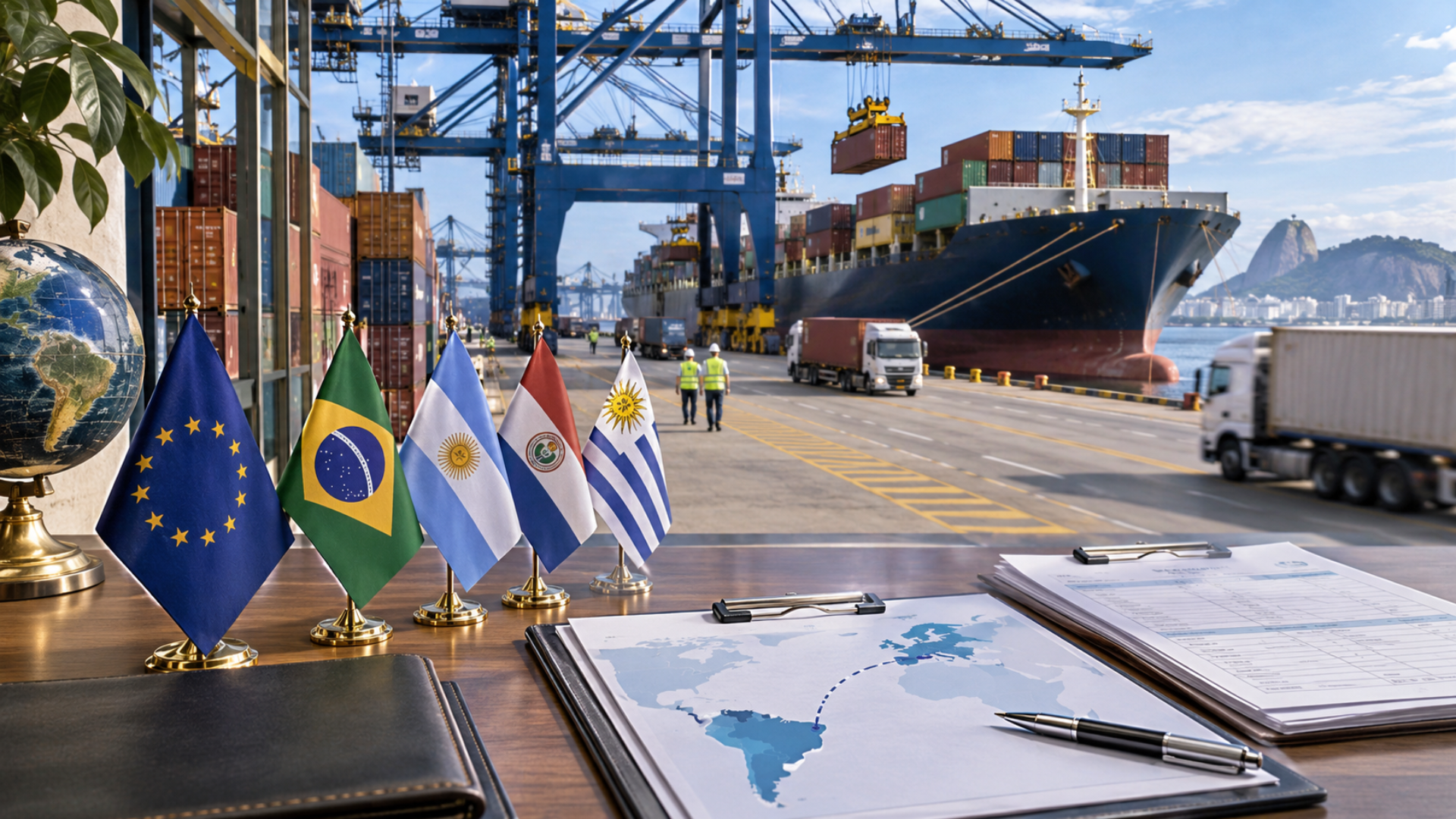
From May 1st, 2026 the Interim Trade Agreement (ITA) The EU-Mercosur agreement has entered into a phase of provisional implementation with Argentina, Brazil, Paraguay and Uruguay. (while Bolivia remains excluded for the time being).
For Italian companies, therefore, this is no longer an agreement to be observed only in the future, but of one of the most important free trade agreements of the European Union that will be in effect in 2026. The first tariff reductions are already in effect, and, depending on the product, the tariffs will be gradually reduced or eliminated over the coming years.
The agreement covers a market of approximately 270 million consumers in Mercosur and provides for the progressive elimination of tariffs on more than 90% of the products exported by the EU to the area.
The potential for Italy is particularly significant. In 2025, Italian trade with the Mercosur area reached 14.7 billion euros. (+7.3% over 2024), While Italian exports reached 7.6 billion, driven mainly by machinery. (33,4%), means of transport (13,8%) and pharmaceutical (9,9%).
But the advantage is not automatic. To really take advantage of the agreement, it is necessary to check, product by product:
the customs code (HS classification and TARIC/NCM entry);
the starting duty (MFN base rate applied before May 1st, 2026);
The reduction calendar the tariff provided for the specific commodity category;
the rules of origin preferential treatment and the maximum threshold for non-EU components;
the necessary documentation (including registration in the REX system for shipments over 6,000 euros);
The impact on the price sdoganato (landed price) and on the margins;
the country and the commercial channel to be prioritized.
In this article we analyze what has changed since May 1st, 2026, which Italian sectors can benefit most from the agreement and how to turn the reduction of tariffs into a real business opportunity.
EU-Mercosur Agreement: what actually came into effect?
On January 17, 2026, the European Union and Mercosur signed two separate instruments in Asunción, available on the official page of the European Commission on’EU-Mercosur Agreement:
l’Interim Trade Agreement – ITA, focused on the commercial components of the agreement.
From On May 1st 2026, ITA is applied provisionally between the EU and Argentina, Brazil, Paraguay and Uruguay, After completing the internal procedures required in the four South American countries.
The Interim Trade Agreement will subsequently be replaced by the full partnership agreement when the latter has completed the most elaborate ratification process foreseen at the European level.
It is also important to clarify another point.
The Bolivia, Although it joined Mercosur in 2024, It is not currently within the scope of commercial application of the EU-Mercosur agreement.
For companies that are building a regional strategy, therefore, Argentina, Brazil, Paraguay and Uruguay must be analyzed separately from Bolivia.
What has changed concretely since May 1st, 2026?
The most immediate change concerns the Customs duties. The Mercosur will progressively eliminate tariffs on approximately 90% of tariff plans, While the European Union will liberalize a similar quota for imports from the South American region, progressive elimination means that not all products benefit from the same advantage at the same time.
For some goods the duty was eliminated from the very first day. For others a reduction process has begun that may take some time:
4 years (rapid reduction for non-sensitive industrial goods and semi-finished products);
7 years o 8 years (intermediate sector that includes, for example, textiles and clothing);
10 years (main component for industrial machinery, automotive and pharmaceutical components);
up to 15 years (for more sensitive productions).
There are also tariff quotas (import quota at zero or reduced duty), Exceptions and specific regimes.
Rules of origin: the real switch of the agreement
The reduction of the duty is only valid if the preferential origin is respected. European It can be demonstrated. Before changing prices and commercial strategies, it is therefore advisable to verify:
Customs classification of the product (6-digit HS code and TARIC code);
specific rule of origin (PSR – Product Specific Rule) provided for by the agreement;
distinct base (BOM) and percentage weight of non-EU components on the ex-factory price (EXW);
statements of long-term origin of the suppliers;
traceability of materials and application of the bilateral EU-Mercosur cumulation;
correct issuance of the declaration of origin by registering with the REX system (mandatory for shipments over 6,000 euros).
Otherwise, the risk is to build a commercial strategy based on a tariff advantage that cannot subsequently be used.
The European Commission also allows the submission of an application for preferential treatment even after customs clearance, under certain conditions and generally within two years of release for free circulation.
For companies that regularly export to the area, however, it is much more efficient to properly structure the origin. before shipment.
Italy and Mercosur: how much is the trade relationship worth today?
The agreement comes at a time when trade relations are already significant. In In 2025, Italian trade with the Mercosur countries reached 14.7 billion euros, up 7.3% compared to the previous year. Italian exports to the area amounted to 7.6 billion euros. The composition of exports highlights some of the sectors in which Italy can benefit most from the new commercial phase:
machinery: 33.4%, equivalent to approximately 2.5 billion euros;
means of transport: 13.8%, approximately 1.1 billion;
pharmaceutical, chemical-medicinal and botanical: 9.9%, approximately 747 million.
However, the weight of the individual markets is very different.
The Brazil absorbs about 76.6% of Italian exports to the Mercosur, followed by:
This data already highlights a first strategic implication: There is no single Mercosur strategy.
The agreement is common, but the size, demand, regulation and commercial channels remain profoundly different from country to country, making it necessary to structure a Dedicated growth path for key markets such as Brazil.
The first data after the implementation of the agreement
It is still too early to attribute the trend in trade solely to the agreement. However, the initial data indicate a strong trade dynamic.
According to the Farnesina, in the two-month period May-June 2026, Therefore, immediately after the start of the provisional application, the exchange of goods between the EU and Mercosur was equal to 21.79 billion euros, against 18.30 billion in the same period in 2025. The growth was therefore of about 3.5 billion euros, equivalent to 19%. In the first seven months of 2026, Italian trade with the area reached approximately 8.8 billion euros.
These data do not yet allow for measuring the structural effect of the agreement, but they do show a very dynamic commercial context.
Machinery and equipment: one of the most interesting sectors for Italy
The machinery sector It is probably one of the most important for Italian companies. Before the agreement, numerous categories of machinery and equipment exported from the EU were subject to tariffs ranging between 14% and 20%.
With the implementation of ITA, the tariffs will be gradually eliminated on 93% of European exports of machinery and equipment, Generally over a period of ten years. A first reduction of between approximately 1.3 and 1.7 percentage points has already been implemented since May 1st. For Italian companies active in:
The central theme then becomes understanding. How much the lower tariff changes the competitive comparison with local suppliers, Chinese, American or Asian.
Even a seemingly limited reduction can be significant when it comes to high-value installations.
Automotive and components
The automotive sector is one in which the initial effect is particularly evident. Before the agreement, European cars could be subject to a duty of 10%. 35%. From May 1st:
for electric and hybrid vehicles, the duty has been reduced from 35% to 25%;
For many cars with an internal combustion engine, it has dropped from 35% to 17,5%;
For 90% of European exports of auto components, a process of gradual elimination has begun over a ten-year period.
For Italy, the opportunities concern not only finished vehicles but also:
components;
mechanical systems;
automation;
machinery for production lines;
testing;
electronics;
Technologies for mobility.
Pharmaceutical and chemical
Pharmaceuticals are also among the sectors that could potentially benefit. In some cases, European pharmaceutical products were subject to tariffs of up to 100%. 14%. For about 90% of EU exports, a ten-year tariff elimination process has now begun.
This creates a potential advantage for:
pharmaceutical products;
ingredients;
specialty chemicals;
pharmaceutical machinery;
packaging;
Laboratory technologies.
The reduction of tariffs does not, however, eliminate regulatory requirements, registrations, or local authorizations.
Lower customs duty does not mean a lesser need for compliance.
Textiles, fashion and design
Another interesting sector is textiles. According to the European Commission, some European textile products were subject to tariffs up to 35%. With the agreement, an eight-year process of complete elimination began, with a first reduction of approximately 3.9 percentage points already on the first day. For fashion, accessories and design, the reduced duty can be used in different ways:
improve the margin;
lower the final price;
increase the distributor's remuneration;
fund marketing and brand development.
The choice depends mainly on the positioning.
A premium brand might prefer to protect its price and improve its margins and commercial investments. A company that wants to quickly gain market share might instead use its tariff advantage to become more competitive.
Food & Beverage: what changes?
L’agribusiness It is one of the most important sectors for Made in Italy. Since May 1st, some European products already benefit from the’complete elimination of the duty, Whereas for others a gradual process has begun. Among the products affected by the progressive liberalization are:
wine;
spirits;
olive oil;
pasta;
chocolate;
beer.
For other products, specific tariff quotas are provided. The Commission indicates, for example, new quotas for:
cheese;
powdered milk;
infant formula;
chocolate;
garlic;
tomato preparations.
In 2024, Italian agri-food exports to Mercosur were worth approximately 489 million euros and numerous categories were subject to tariffs ranging from 27% to 55%.
The tariff reduction can therefore have a significant impact on the competitiveness of certain Italian specialties.
57 Protected Italian Geographical Indications
The agreement also concerns the protection of Made in Italy products. They will be protected in Mercosur 57 Italian Geographical Indications, Within the 344 European IG’s recognized by the agreement. Among these are, among others:
Parmigiano Reggiano;
Prosciutto di Parma;
Grana Padano;
Gorgonzola;
Mozzarella di Bufala Campana;
Mortadella Bologna;
Aceto Balsamico di Modena;
Pasta from Gragnano;
Barolo;
Brunello di Montalcino;
Chianti;
Prosecco;
Grappa.
The protection of Geographical Indications is particularly relevant in markets where well-known Italian denominations have historically been used for local or imitation products. For food & beverage companies, therefore, the agreement can strengthen at the same time tariff competitiveness and protection of positioning.
Public services and contracts: the agreement does not only concern goods
Limiting the agreement to tariff reduction would be reductive. ITA also introduces new opportunities for services and for the presence of European companies in the Mercosur markets. The sectors concerned include:
financial services;
telecommunications;
postal services;
professional services;
activities related to the temporary presence of specialized personnel.
The agreement also expands access to Public contracts, By creating opportunities for European companies active in infrastructure, engineering, technology, industrial services and supplies. For many manufacturing companies this means that the export of a product can be accompanied by:
maintenance;
engineering;
installation;
training;
digital services;
After-sales service.
The commercial strategy can then evolve from the simple export of goods to the sale of Integrated solutions.
How has the Italian presence in the area grown?
The Mercosur was already a strategic area before the agreement. Between 2019 and 2025, Italian trade with the bloc grew by 11%. 51%.
In September 2026, the Farnesina also organized a system mission in Argentina and Brazil with over 100 Italian companies, Together with ICE, SACE, SIMEST and Confindustria.
It is an important signal: the agreement is not interpreted only as a tariff issue, but as a platform to strengthen cooperation. investments, industrial partnerships, technology and commercial presence.
What should Italian companies do concretely?
To turn the agreement into a real business opportunity, it is useful to adopt a structured approach. in 10 operational steps:
Mapping the products
Correctly identifying HS and CN codes.
Check the base duty
Understanding how much was being paid before the agreement.
Identifying the tariff category
Determine when the reduction will occur and when the duty will reach zero.
Analyzing the preferential origin
Check the base model, extra-EU components, and product-specific rules.
Check the REX position
For exports exceeding 6,000 euros, verify that the registration is correct in the Registered Exporter System.
Recalculate the landed price
Measuring the real impact on the price in the destination market.
Comparing competitors
Understanding whether the tariff advantage changes the positioning compared to local or other country producers.
Review the channel
Consider whether distributors, importers or direct presence remain the most effective model.
Checking local compliance
The agreement does not eliminate registration, technical standards, health requirements, or other national regulations.
Choosing the priority markets
Brazil, Argentina, Uruguay and Paraguay must be evaluated individually.
From tariffs to strategy: the real opportunity for Italian companies
The effect of the agreement should not be read solely in terms of customs savings. Its true value emerges when the tariff reduction is combined with a commercial strategy. with a strategic analysis of foreign markets.
For example, an Italian company may discover that:
a product that was previously too expensive becomes competitive;
a distributor can obtain a more interesting margin;
It becomes sustainable to create a local stock;
a new segment of customers can be reached;
a premium offer can maintain the price by increasing the margins;
An industrial product can become competitive compared to a competitor from Asia.
The agreement can therefore also lead to reviewing decisions made in the past. Markets or products previously excluded for price reasons might today merit a new evaluation.
Conclusions: What has really changed after May 1st, 2026?
The EU-Mercosur Agreement has entered a new phase. From May 1st, 2026, companies can begin to concretely use the preferences provided by the Interim Trade Agreement with Argentina, Brazil, Paraguay and Uruguay. There are significant opportunities for Italian companies in sectors such as:
machinery;
automotive;
pharmaceutical;
chemistry;
textiles and fashion;
food & beverage;
services.
But the most important message is another. The benefit is not automatic and is not the same for all products.
It is necessary to verify the origin, customs code, tariff schedule and documentation, and, above all, to decide how to use the advantage obtained.
The Interim Trade Agreement (ITA) is applied provisionally from May 1, 2026 between the EU and Argentina, Brazil, Paraguay and Uruguay.
Does Bolivia fall under the agreement?
Not currently. Although Bolivia is a member of the Mercosur since 2024, it is not currently included in the scope of application of the EU-Mercosur trade agreement.
Were all the tariffs eliminated on May 1st?
No. Some tariffs have been eliminated immediately, while others are gradually reduced over several years over 4, 7, 8, 10 or 15 years. There are also tariff quotas and special categories.
How is the preferential tariff obtained?
The product must comply with the rules of origin stipulated by the agreement and the exporter must prepare a correct declaration of origin. For EU exports over 6,000 euros, the REX number is generally required.
Which Italian sectors can benefit the most?
Among the most interesting sectors are machinery, transportation vehicles, components, pharmaceuticals, chemicals, textiles, fashion, and agro-food products.
How many Italian Geographical Indications will be protected?
The agreement protects 57 Italian Geographical Indications (DOP and IGP), including Parmigiano Reggiano, Prosciutto di Parma, Grana Padano, Prosecco and numerous other products.
Does the agreement also eliminate non-tariff barriers?
The agreement introduces simplifications and new disciplines in customs, SPS, services, public procurement, and intellectual property, but does not eliminate all national technical and regulatory requirements (such as INMETRO, ANVISA, or MAPA certifications in Brazil). Companies must continue to verify compliance in their individual markets.
SHARE ARTICLESassy Social Share
If you want to learn more about the content of this article










 Italian
 English